A Review of Descent Based Optimisation Algorithms
February 20, 2026
1 Introduction #
Let $f : \mathbb{R}^n \rightarrow \mathbb{R}$ denote a smooth function, then the aim of a general optimisation (minimisation) problem is to find $\min _{\theta} f (\theta)$ and the corresponding point(s) at which this minimum is attained $\theta^{\ast} := \operatorname{argmin}_{\theta} f (\theta)$. If the function is simple enough, we simply solve $\nabla f = 0$. Although, if $f$ is complex, and the derivative is not easy to solve, one widely used option is to take an iterative approach, i.e. find a sequence of points $(\theta _{k})_{k \in \mathbb{N}}$ such that as $\theta _{k} \rightarrow \theta^{\ast}$, we get $f (\theta _{k}) \rightarrow f (\theta^{\ast})$ as $k \rightarrow \infty$.
A general iterative approach can be classified as follows: find a sequence $(\theta _{k})_{k}, (\alpha _{k})_{k}, (\boldsymbol{g}_{k})_{k}$ such that
$$ \begin{eqnarray} \theta _{k + 1} & = & \theta _{k} + \boldsymbol{\alpha}_{k} \boldsymbol{d}_{k} \nonumber \end{eqnarray} $$where $\boldsymbol{d}_{k} \in \mathbb{R}^n$ represents the direction that one needs to take to get to the next point, and $\boldsymbol{\alpha}_{k} \in \mathbb{R}^{n \times n}$ represents the scale (also known as learning-rate), i.e. the size of the step one needs to take in the direction $\boldsymbol{d}_{k}$ to reach the next point, where the next point $\theta _{k + 1}$ is slightly closer to the optimal solution $\theta^{\ast}$.
Given this classification, we are left with two free parameters, scale and direction. The question we ask ourselves now is, how should we choose these? The history of descent-based optimisation can be understood as a series of increasingly refined answers to this question. In this article, we outline the history of descent based algorithms, and outline their approaches, see [1] for an additional summary.
2 Gradient Descent #
We start with simple gradient descent (GD), also known as batch gradient descent (BGD) in machine learning literature, which was initially introduced by Cauchy in [2] .
Let $(\theta _{k})_{k}$ denote some sequence of parameters that we wish to define such that $\theta _{k} \rightarrow \theta^{\ast}$ as $k \rightarrow \infty$. If we assume that $\theta _{k + 1} = \theta _{k} + h$ for $h \in \mathbb{R}^n$ with $\| h \|$ small, then by the multivariate Taylor expansion, we have that
$$ f (\theta _{k + 1}) = f (\theta _{k} + h) = f (\theta _{k}) + h^T \nabla f (\theta _{k}) +\mathcal{O} (\| h \|^2) . $$A natural choice of $h$ would be such that $h^T \nabla f (\theta _{k}) < 0$, i.e. iterative steps make $f$ smaller (assuming that the first order expansion well approximates $f$). By Cauchy-Schwarz
$$ \begin{eqnarray} h^T \nabla f (\theta _{k}) & \geqslant & - \| h \| \| \nabla f (\theta _{k}) \| \nonumber \end{eqnarray} $$with equality holding when
$$ \begin{eqnarray} h & := & - \eta \frac{\nabla f (\theta _{k})}{\| \nabla f (\theta _{k}) \|} \nonumber \end{eqnarray} $$for some $\eta > 0$, also called the learning rate. That is, the optimal direction for the greatest reduction in $f$ is the direction of steepest descent. Summarising, we get the following evolution equation
$$ \begin{eqnarray} \theta _{k + 1} & = & \theta _{k} - \alpha _{k} \nabla f (\theta _{k}) \nonumber\\\ \alpha _{k} & = & \frac{\eta}{\| \nabla f (\theta _{k}) \|} \nonumber \end{eqnarray} $$for some free parameter $\eta > 0$. As $\eta$ is free, we may simplify this entirely, and consider instead $\alpha _{k}$ the free parameter, and write
$$ \begin{eqnarray} \theta _{k + 1} & = & \theta _{k} - \alpha \nabla f (\theta _{k}) \nonumber \end{eqnarray} $$for some predefined learning rate $\alpha$.
Algorithm 1 (Gradient Descent)
Require: $\alpha$: Step size
Require: $f (\theta)$: Objective function with parameters $\theta$
Require: $\theta _{0}$: Initial parameter vector
$t \leftarrow 0$ (Initialise time-step)
while $\theta _{t}$ not converged do
$t \leftarrow t + 1$
$g_{t} \leftarrow \nabla _{\theta} f_{t} (\theta _{t - 1})$ (Get gradients with respect to objective at time $t$)
$\theta _{t} \leftarrow \theta _{t - 1} - \alpha \cdot g_{t}$ (Update parameters)
end while
return $\theta _{t}$ (Resulting parameters)
Example 1 (Machine Learning).
In supervised learning, we are often given a dataset of $N$ samples $(x_{i}, y_{i})$. In such a scenario, we choose a model $h_{\theta} (x)$ parametrised by some $\theta \in \mathbb{R}^n$ and a loss function $\ell (h_{\theta} (x), y)$ that measures the prediction error made by the model. The empirical risk is the average loss over the training data
$$ \begin{eqnarray} f (\theta) & := & \frac{1}{N} \sum_{i = 1}^N \ell (h_{\theta} (x_{i}), y_{i}), \nonumber \end{eqnarray} $$and the goal is to find $\theta^{\ast}$ that minimises this average loss. A simple batch gradient descent algorithm could then be written as
$$ \begin{eqnarray} \theta _{k + 1} & = & \theta _{k} - \alpha _{k} \frac{1}{N} \sum_{i = 1}^N \nabla \ell (h_{\theta _{k}} (x_{i}), y_{i}) . \nonumber \end{eqnarray} $$For large $N$, this would require $N$ gradient computations, which can be quite slow. Thankfully, there are remedies to this, which we discuss later under stochastic gradient descent and mini-batch gradient descent.
Pathologies #
Sensitive to Learning Rate. The learning rate needs to be chosen carefully as to make sure convergence occurs, even for a convex function. If chosen too large, convergence does not occur, and if too small, convergence is slow.
Locally Optimal. Solutions can often get stuck in local optima if the function is not convex, and therefore the approach is not necessarily the best to choose when seeking for globally optimal solutions. A simple way to address this is to employ noisy learning rates, i.e. set $\alpha = \eta + \varepsilon$ for some random noise $\varepsilon$.
Inefficient. The approach can be computationally inefficient for large $n$ or for machine learning problems with large training data, i.e. large $N$.
3 Stochastic Gradient Descent #
Gradient descent as described above requires the exact gradient $\nabla f$ at every step. In many settings this is either too expensive or impossible: the function $f$ may be an expectation over a large (or infinite) population, or it may be a sum over a dataset so large that evaluating every term at each iteration is impractical. A natural question arises: what happens if we replace the true gradient with a noisy estimate $g = \nabla f + \varepsilon$, where $\varepsilon$ is some noise can the algorithm still converge?
3.1 Robbins-Monro Conditions #
Fortunately, for the many methods that rely on this core principle, the answer is yes, provided the learning rate is dynamic and is chosen appropriately. The seminal work of Robbins and Monro, [3] , establishes that the iteration
$$ \begin{eqnarray} \theta _{k + 1} & = & \theta _{k} - \alpha _{k} g (\theta _{k}) \nonumber \end{eqnarray} $$where $g$ is an unbiased estimator of $\nabla f$, i.e. $\mathbb{E} [g (\theta)] = \nabla f (\theta)$, converges to $\theta^{\ast}$ in probability provided the step sizes, $\alpha _{k} > 0$, satisfy the following three conditions:
- $\sum_{k = 1}^{\infty} \alpha _{k} = \infty$. The total distance the algorithm can travel must be unbounded.
- $\sum_{k = 1}^{\infty} \alpha _{k}^2 < \infty$. The steps must eventually shrink fast enough to damp out the noise.
These are referred to as the Robbins-Monro conditions. Together, the conditions create a tension: the step sizes must shrink but not too quickly. The canonical choice $\alpha _{k} = c / k$ for some constant $c > 0$ satisfies both, and is the most commonly used schedule in the stochastic approximation literature.
The Robbins-Monro result reveals that gradient descent is inherently robust to noise: convergence is preserved as long as the noise is unbiased and the learning rate decays appropriately. This observation opens the door to intentionally introducing noise, trading exactness for computational efficiency. This is precisely the idea behind stochastic gradient descent as it is used in modern machine learning: we do not merely tolerate noise in the gradient, we engineer it by subsampling the data.
3.2 Modern Interpretation #
We now make the connection to machine learning concrete. Recall Example 1, where the objective is the empirical risk $f (\theta) = \frac{1}{N} \sum_{i = 1}^N \ell (h_{\theta} (x_{i}), y_{i})$. Batch gradient descent computes the full sum at every step, costing $\mathcal{O} (N)$ per iteration. SGD applies the Robbins-Monro framework by replacing the true gradient with a single-sample estimate: draw $\sigma \sim \operatorname{Uniform} \lbrace 1, \ldots, N \rbrace$ and set $g (\theta) = \nabla \ell (h_{\theta} (x_{\sigma}), y_{\sigma})$, giving the evolution equation
$$ \begin{eqnarray} \theta _{k + 1} & = & \theta _{k} - \alpha _{k} \nabla \ell (h_{\theta _{k}} (x_{\sigma (k)}, y_{\sigma (k)})) . \nonumber \end{eqnarray} $$Indeed, we have that $g$ is an unbiased estimator of $\nabla f$, as
$$ \mathbb{E} [g (\theta) | ((x_{i}, y_{i}))_{i = 1}^N] = \frac{1}{N} \sum_{j = 1}^N \nabla \ell (h_{\theta _{k}} (x_{j}), y_{j}) = \nabla f (\theta) . $$Now, instead of requiring one to compute the gradient at $N$ different points, one is only required to compute the gradient at one single point. This adds noise to the descent process towards the minimum, visually seen as a jitter in the optimal path, but with this increase in noise, we get a much more computationally efficient algorithm.
Algorithm 2 (Stochastic Gradient Descent)
Require: $\alpha _{0}$: Initial step size
Require: $f (\theta) = \frac{1}{N} \sum_{i = 1}^N f_{i} (\theta)$: Stochastic objective function with parameters $\theta$
Require: $\theta _{0}$: Initial parameter vector
$t \leftarrow 0$ (Initialise time-step)
while $\theta _{t}$ not converged do
$t \leftarrow t + 1$
$\alpha _{t} \leftarrow \varphi (\alpha _{t - 1}, \ldots, \alpha _{0})$ (Decay step size according to Robbins-Monro conditions)
$i_{t} \sim U \lbrace 1, \ldots, N \rbrace$ (Sample a data point uniformly at random)
$g_{t} \leftarrow \nabla _{\theta} f_{i_{t}} (\theta _{t - 1})$ (Get gradients with respect to stochastic objective at time $t$)
$\theta _{t} \leftarrow \theta _{t - 1} - \alpha _{t} \cdot g_{t}$ (Update parameters)
end while
return $\theta _{t}$ (Resulting parameters)
3.3 Mini Batch Optimisation #
Mini-batch optimisation is a middle ground between batch gradient descent and stochastic gradient descent. While batch gradient descent requires the calculation of all $N$ gradients, and stochastic gradient descent requires only one, mini-batch gradient descent computes the gradient over a random subset of size $b$. The resulting estimator $g_{t} = \frac{1}{b} \sum_{i \in \mathcal{B}_{t}} \nabla f_{i} (\theta)$ is still unbiased, but its variance is reduced by a factor of $b$ relative to single-sample SGD, since $\operatorname{Var} (g_{t}) = \frac{1}{b} \operatorname{Var} (\nabla f_{i})$. This smoothens the convergence to the (local) optimum while keeping the per-step cost at $\mathcal{O} (b)$ rather than $\mathcal{O} (N)$. This approach is typically used when compute parallelisation is available, and in practice, $b$ is typically chosen as a power of 2 to exploit hardware parallelism on GPUs.
Algorithm 3 (Mini-Batch Gradient Descent)
Require: $\alpha _{0}$: Initial step size
Require: $f (\theta) = \frac{1}{N} \sum_{i = 1}^N f_{i} (\theta)$: Stochastic objective function with parameters $\theta$
Require: $\theta _{0}$: Initial parameter vector
$t \leftarrow 0$ (Initialise time-step)
while $\theta _{t}$ not converged do
$t \leftarrow t + 1$
$\alpha _{t} \leftarrow \varphi (\alpha _{t - 1}, \ldots, \alpha _{0})$ (Decay step size)
$\mathcal{B}_{t} \sim$Sample $b$ indices from $\lbrace 1, \ldots, N \rbrace$ without replacement
$g_{t} \leftarrow \frac{1}{b} \sum_{i \in \mathcal{B}_{t}} \nabla _{\theta} f_{i} (\theta _{t - 1})$ (Compute mini-batch gradient estimate)
$\theta _{t} \leftarrow \theta _{t - 1} - \alpha _{t} \cdot g_{t}$ (Update parameters)
end while
return $\theta _{t}$ (Resulting parameters)
Pathologies #
Oscillation. Suppose that our objective $f$ has narrow valleys with the optimum lying within that valley. Then, the gradient points mostly across the valley (towards the steep walls) and only weakly along it (towards the minimum). In particular, SGD will oscillate back and forth across the valley while making slow progress along it.
Gradient Noise. In the stochastic setting $g_{k}$ fluctuates around $\nabla f (x_{k})$. These fluctuations cause the trajectory to jitter, particularly near the optimum.
Both pathologies share a common structure, the harmful components of the gradient (oscillations, noise) tend to change sign frequently, while the useful components (the persistent descent direction) are consistent across iterations. This suggests a natural fix, average the gradients over time. Components that are consistent will reinforce; components that oscillate or fluctuate will cancel.
4 Momentum and Adaptive Learning Rates #
Returning to our general framework, SGD with a fixed or decaying scalar learning rate sets $\boldsymbol{\alpha}_{k} = \alpha _{k} I$ and $\boldsymbol{d}_{k} = - g_{k}$: it treats every coordinate identically and uses only the current gradient to choose its direction. The pathologies identified above suggest two independent avenues for improvement
- improve the direction $\boldsymbol{d}_{k}$ by averaging gradients over time,
- improve the scale $\boldsymbol{\alpha}_{k}$ by adapting the learning rate to each coordinate individually.
We address these in turn.
4.1 Directional Improvements - Momentum #
The method of momentum, introduced by Polyak in [4] and surveyed in [5] , is designed to accelerate learning in the face of the two pathologies described above: high-curvature oscillations and stochastic noise. The core idea is to replace the raw gradient $g_{k}$ with a running average of past gradients, which we call the velocity $m_{k}$. Because harmful components (oscillations, noise) change sign frequently, averaging cancels them out; because the useful descent direction is consistent, averaging reinforces it.
4.1.1 Exponential Moving Average #
One of the simplest forms of temporal averaging is the exponential moving average (EMA). Define the velocity $m_{k}$ recursively as
$$ m_{k} = \beta m_{k - 1} + (1 - \beta) g_{k} $$with $m_{0} = 0$ and $\beta \in [0, 1)$, where $\beta$ controls how much history to retain. Expanding the recursion gives the weighted sum of all past gradients
$$ \begin{eqnarray} m_{k} & = & (1 - \beta) \sum_{j = 1}^k \beta^{k - j} g_{j} . \nonumber \end{eqnarray} $$The weights $(1 - \beta) \beta^{k - j}$ decay exponentially into the past: recent gradients contribute most, and the effective window of history is approximately $1 / (1 - \beta)$ steps (e.g. $\beta = 0.9$ averages roughly the last 10 gradients).
4.1.2 Polyak’s Heavy Ball Method #
The classical momentum formulation due to Polyak, see [4] , uses a slightly different convention that absorbs the $(1 - \beta)$ factor into the learning rate:
$$ \begin{eqnarray} m_{k} & = & \beta m_{k - 1} + g_{k}, \nonumber\\\ \theta _{k + 1} & = & \theta _{k} - \alpha m_{k} . \nonumber \end{eqnarray} $$Expanding the second line reveals the structure
$$ \begin{eqnarray} \theta _{k + 1} & = & \underbrace{\theta _{k} - \alpha g_{k}}_{\text{classical SGD structure}} - \underbrace{\alpha \beta m_{k - 1}}_{\text{momentum correction}} . \nonumber \end{eqnarray} $$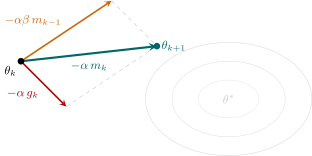
Under this convention, the velocity expands as $m_{k} = \sum_{j = 1}^k \beta^{k - j} g_{j}$, which differs from the normalised EMA only by the factor $(1 - \beta)$. Since $\alpha$ is a free parameter, the two formulations yield identical trajectories after rescaling.
In practice, Polyak’s convention is more common because the learning rate $\alpha$ decouples from $\beta$: the expansion $\theta _{k + 1} = \theta _{k} - \alpha g_{k} - \alpha \beta m_{k - 1}$ shows that $\alpha$ directly controls the per-gradient step size, and setting $\beta = 0$ recovers vanilla SGD with step size $\alpha$. By contrast, the normalised EMA gives an effective per-gradient step of $\alpha (1 - \beta)$, so changing $\beta$ implicitly changes the learning rate too.
Algorithm 4 (SGD with Momentum (Polyak))
Require: $\alpha$: Step size
Require: $\beta \in [0, 1)$: Momentum coefficient (typically 0.9)
Require: $f (\theta) = \frac{1}{N} \sum_{i = 1}^N f_{i} (\theta)$: Stochastic objective function with parameters $\theta$
Require: $\theta _{0}$: Initial parameter vector
$m_{0} \leftarrow 0$ (Initialise velocity)
$t \leftarrow 0$ (Initialise time-step)
while $\theta _{t}$ not converged do
$t \leftarrow t + 1$
$i_{t} \sim U \lbrace 1, \ldots, N \rbrace$ (Sample data point)
$g_{t} \leftarrow \nabla _{\theta} f_{i_{t}} (\theta _{t - 1})$ (Compute stochastic gradient)
$m_{t} \leftarrow \beta \cdot m_{t - 1} + g_{t}$ (Update velocity)
$\theta _{t} \leftarrow \theta _{t - 1} - \alpha \cdot m_{t}$ (Update parameters)
end while
return $\theta _{t}$ (Resulting parameters)
4.1.3 Nesterov Accelerated Gradient #
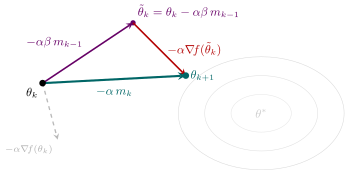
Nesterov proposed a subtle but important variant, see [6] . Standard momentum computes the gradient at the current position $\theta _{k}$ and then adds the momentum correction. Nesterov reverses the order, first apply the momentum to get a lookahead point, then compute the gradient there
$$ \begin{eqnarray} \tilde{\theta}_{k} & = & \theta _{k} - \alpha \beta m_{k - 1} \nonumber\\\ m_{k} & = & \beta m_{k - 1} + \nabla f (\tilde{\theta}_{k}) \nonumber\\\ \theta _{k + 1} & = & \theta _{k} - \alpha m_{k} . \nonumber\\\ & = & \theta _{k} - \alpha \nabla f (\tilde{\theta}_{k}) - \alpha \beta m_{k - 1} \nonumber \end{eqnarray} $$The intuition is corrective: since momentum will carry us to approximately $\tilde{\theta}_{k}$ anyway, we should evaluate the gradient where we are about to be, not where we currently are. If the momentum is overshooting (e.g. past a minimum), the gradient at the lookahead point already points back, providing an earlier course correction. For convex quadratics, this achieves the optimal convergence rate among first-order methods: $\mathcal{O} (1 / k^2)$ versus $\mathcal{O} (1 / k)$ for standard gradient descent.
4.2 Scaling Improvements #
Having improved the direction with momentum, we now turn to the scale $\boldsymbol{\alpha}_{k}$. A single scalar learning rate treats every parameter identically, yet different parameters may live in very different landscapes. Some directions curve steeply and need small steps, while others are nearly flat and need large ones.
One could try to fix this with second-order information. Newton’s method replaces the scalar $\alpha I$ with the inverse Hessian $H^{- 1}$, so that the step $\theta _{k + 1} = \theta _{k} - H^{- 1} \nabla f$ scales each gradient component by the inverse curvature along that direction. However, computing and inverting the $n \times n$ Hessian costs $\mathcal{O} (n^3)$, which is prohibitive in modern applications. The adaptive methods below take a different, cheaper approach: they use only first-order information to give each coordinate its own step size. The form of this scaling is not chosen by analogy with Newton, but emerges from a principled analysis of regret which appears in online optimisation.
Regret and Per-Coordinate Step Sizes #
SGD already has the structure of an online algorithm, that is, at each step $t$, we observe the stochastic gradient $g_{t} = \nabla f_{i_{t}} (\theta _{t})$ and must commit to $\theta _{t + 1}$ before seeing any future gradients. Because $g_{t}$ is stochastic, we cannot guarantee a loss reduction at every step. What can we guarantee instead?
A natural measure is regret, which is the total excess loss accumulated along our trajectory relative to the single best fixed point in hindsight
$$ R_{T} := \sum_{t = 1}^T f_{t} (\theta _{t}) - \min _{\theta} \sum_{t = 1}^T f_{t} (\theta) . $$Regret is always non-negative, and an algorithm is considered good if $R_{T}$ grows sub-linearly in $T$, meaning the average per-step penalty $R_{T} / T \rightarrow 0$. Standard online gradient descent, with a scalar step size $\alpha _{t} = \alpha / \sqrt{t}$, achieves $R_{T} =\mathcal{O} \left( \sqrt{T} \right)$, but it treats every coordinate identically.
To allow per-coordinate step sizes, we generalise the update to $\theta _{t + 1} = \theta _{t} - X g_{t}$, where $X =\operatorname{diag} (\alpha _{1}, \ldots, \alpha _{n})$ is a fixed positive-definite diagonal matrix (we will make it data-dependent momentarily).
where $D_{i} = \max _{t} | \theta _{t, i} - \theta _{i}^{\ast} |$ is the maximum distance coordinate $i$ travels from the optimum and $G_{T, i} = \sum_{t = 1}^T g_{t, i}^2$ is the accumulated squared gradient.
Proof.
Let each $f_{t}$ be convex. Fix coordinate $i$ and write $\delta _{t, i} = \theta _{t, i} - \theta _{i}^{\ast}$.
Step 1 (Convexity). Since $f_{t}$ is convex, $f_{t} (\theta _{t}) - f_{t} (\theta^{\ast}) \leqslant g_{t}^{\top} (\theta _{t} - \theta^{\ast}) = \sum_{i} g_{t, i} \delta _{t, i}$. It suffices to bound each $\sum_{t} g_{t, i} \delta _{t, i}$.
Step 2 (One-step identity). From the update rule, $\delta _{t + 1, i} = \delta _{t, i} - \alpha _{i} g_{t, i}$. Squaring both sides and rearranging,
$$ g_{t, i} \delta _{t, i} = \frac{\delta _{t, i}^2 - \delta _{t + 1, i}^2}{2 \alpha _{i}} + \frac{\alpha _{i} g_{t, i}^2}{2} . $$Step 3 (Telescope). Summing from $t = 1$ to $T$, the first term telescopes directly:
$$ \sum_{t = 1}^T g_{t, i} \delta _{t, i} = \frac{\delta _{1, i}^2 - \delta _{T + 1, i}^2}{2 \alpha _{i}} + \frac{\alpha _{i}}{2} \sum_{t = 1}^T g_{t, i}^2 \leqslant \frac{D_{i}^2}{2 \alpha _{i}} + \frac{\alpha _{i} G_{T, i}}{2} . $$Summing over coordinates gives the stated bound.
The two terms are in direct tension: the first penalises small step sizes (slow progress towards $\theta^{\ast}$), the second penalises large step sizes (overshooting). The optimal $\alpha _{i}$ sits at the balance point, and crucially this balance is different for every coordinate.
Writing the bound in matrix form makes the minimisation transparent. With $G =\operatorname{diag} (G_{T, 1}, \ldots, G_{T, n})$ and $D^2 =\operatorname{diag} (D_{1}^2, \ldots, D_{n}^2)$, the upper bound reads
$$ R_{T} \leqslant \frac{1}{2} \operatorname{tr} (X^{- 1} D^2 + X G) . $$We minimise over all positive-definite $X$ (not just diagonal, the result happens to be diagonal when $G$ and $D^2$ are). Differentiating and setting to zero, $- X^{- 2} D^2 + G = 0$, giving the optimal choice of $X$, $X^{\ast} = D G^{- 1 / 2}$. In the diagonal case this is $\alpha _{i}^{\ast} = D_{i} / \sqrt{G_{T, i}}$, i.e. the optimal step size for coordinate $i$ is inversely proportional to the root accumulated gradient energy, for the non-diagonal case, see [7] .
Of course $G_{T, i}$ is unknown at time $t < T$, but we can substitute the running estimate $G_{t, i} = \sum_{\tau = 1}^t g_{\tau, i}^2$ at each step, giving $\alpha _{t, i} = c_{i} / \sqrt{G_{t, i}}$ with $c_{i}$ a constant. This is monotonically decreasing and tied to the per-coordinate gradient energy. Directions with large or frequent gradients shrink their step size quickly, while directions with rare or small gradients preserve a large effective step size.
Proof.
We verify that $\alpha _{t, i} = c_{i} / \sqrt{G_{t, i}}$, with $G_{t, i} = \sum_{\tau = 1}^t g_{\tau, i}^2$, minimises the per-coordinate regret bound and derive the optimal constant $c_{i}$. For coordinate $i$, the bound contributes
$$ R_{T, i} \leqslant \frac{D_{i}^2}{2 \alpha _{T, i}} + \frac{1}{2} \sum_{t = 1}^T \alpha _{t, i} g_{t, i}^2 . $$Substituting $\alpha _{t, i} = c_{i} / \sqrt{G_{t, i}}$, the first term becomes $D_{i}^2 \sqrt{G_{T, i}} / (2 c_{i})$. For the second term, write $G_{t, i} = G_{t - 1, i} + g_{t, i}^2$ and observe
$$ \frac{g_{t, i}^2}{\sqrt{G_{t, i}}} = \frac{G_{t, i} - G_{t - 1, i}}{\sqrt{G_{t, i}}} \leqslant 2 \left( \sqrt{G_{t, i}} - \sqrt{G_{t - 1, i}} \right), $$where the inequality uses $\sqrt{G_{t}} + \sqrt{G_{t - 1}} \leqslant 2 \sqrt{G_{t}}$. Summing telescopes:
$$ \sum_{t = 1}^T \frac{g_{t, i}^2}{\sqrt{G_{t, i}}} \leqslant 2 \sqrt{G_{T, i}} . $$So the second term is bounded by $c_{i} \sqrt{G_{T, i}}$. Combining,
$$ \mathcal{R}_{T, i} \leqslant \sqrt{G_{T, i}} \left( \frac{D_{i}^2}{2 c_{i}} \+ c_{i} \right) . $$Minimising over $c_{i} > 0$ gives $c_{i} = D_{i} / \sqrt{2}$, and the per-coordinate contribution is $\sqrt{2} D_{i} \sqrt{G_{T, i}}$. Summing over coordinates,
$$ R_{T} \leqslant \sqrt{2} \sum_{i = 1}^n D_{i} \sqrt{\sum_{t = 1}^T g_{t, i}^2} =\mathcal{O} \left( \sum_{i = 1}^n D_{i} \sqrt{\sum_{t = 1}^T g_{t, i}^2} \right) . $$4.2.1 AdaGrad #
AdaGrad (Adaptive Gradient), see [8] , implements exactly the step size derived above, absorbing the coordinate-specific constant into a global learning rate $\alpha$. It maintains the running sum $v_{t, i} = \sum_{\tau = 1}^t g_{\tau, i}^2$ and divides the learning rate for each coordinate by $\sqrt{v_{t, i}}$, plus a regularising constant $\varepsilon$, typically $10^{- 8}$ to avoid division by zero. Parameters that receive many large gradients accumulate a large denominator and take smaller steps, while parameters associated with rare features keep a small denominator and take larger steps.
Algorithm 5 (AdaGrad)
Require: $\alpha$: Step size
Require: $f (\theta) = \frac{1}{N} \sum_{i = 1}^N f_{i} (\theta)$: Stochastic objective function with parameters $\theta$
Require: $\theta _{0}$: Initial parameter vector
$v_{0} \leftarrow 0$ (Initialise second moment estimate)
$t \leftarrow 0$ (Initialise time-step)
while $\theta _{t}$ not converged do
$t \leftarrow t + 1$
$g_{t} \leftarrow \nabla _{\theta} f_{t} (\theta _{t - 1})$ (Get gradients with respect to stochastic objective at time $t$)
$v_{t} \leftarrow v_{t - 1} + g_{t}^2$ (Accumulate squared gradients)
$\theta _{t} \leftarrow \theta _{t - 1} - \alpha \cdot g_{t} / \left( \sqrt{v_{t}} + \varepsilon \right)$ (Update parameters)
end while
return $\theta _{t}$ (Resulting parameters)
The regret bound explains why AdaGrad excels with sparse data: if most gradient entries are zero for a given coordinate, that coordinate’s $v_{t, i}$ stays small, so it retains a large effective step size and makes rapid progress on the rare occasions it does receive a gradient. However, the accumulator can only grow, so the effective learning rate $\alpha / \sqrt{v_{t}}$ monotonically decreases. For convex problems this is desirable, but in deep learning, the learning rate often shrinks to the point that training effectively stalls long before a good minimum is found, which is where the next variant, RMSProp comes in.
4.2.2 RMSProp #
AdaGrad’s regret guarantee relies on the accumulator $v_{t} = \sum_{\tau} g_{\tau}^2$ growing monotonically, ensuring the step size shrinks over time. This is well-suited to the convex, online setting for which it was designed, but in the non-convex landscapes of deep learning, the gradient distribution changes as the optimiser moves through different regions. Early gradients dominate $v_{t}$, leaving the step size permanently small even when the landscape has changed. RMSProp (Root Mean Square Propagation), introduced by Geoffrey Hinton in a Coursera course in 2012, see [9] , fixes this by replacing the full-history sum with an exponential moving average, so that $v_{t}$ tracks the recent second moment of the gradient. This makes the scaling adaptive not just across coordinates but also across time: when the gradient landscape changes, outdated information is forgotten and the effective learning rate can recover.
Algorithm 6 (RMSProp)
Require: $\alpha$: Step size
Require: $\beta \in [0, 1)$: Exponential decay rate for the second moment estimate
Require: $f (\theta) = \frac{1}{N} \sum_{i = 1}^N f_{i} (\theta)$: Stochastic objective function with parameters $\theta$
Require: $\theta _{0}$: Initial parameter vector
$v_{0} \leftarrow 0$ (Initialise second moment estimate)
$t \leftarrow 0$ (Initialise time-step)
while $\theta _{t}$ not converged do
$t \leftarrow t + 1$
$g_{t} \leftarrow \nabla _{\theta} f_{t} (\theta _{t - 1})$ (Get gradients with respect to stochastic objective at time $t$)
$v_{t} \leftarrow \beta \cdot v_{t - 1} + (1 - \beta) g_{t}^2$ (Update biased second raw moment estimate)
$\theta _{t} \leftarrow \theta _{t - 1} - \alpha \cdot g_{t} / \left( \sqrt{v_{t}} + \varepsilon \right)$ (Update parameters)
end while
return $\theta _{t}$ (Resulting parameters)
4.2.3 AdaDelta #
RMSProp solves AdaGrad’s stale-accumulator problem but still requires a global learning rate $\alpha$. AdaDelta, see [10] , removes this hyper-parameter entirely by exploiting a dimensional argument.
Assign hypothetical units to the quantities involved: if $\theta$ has units $[\theta]$ and the loss $f$ has units $[f]$, then the gradient $g = \partial f / \partial \theta$ has units $[f] / [\theta]$. A parameter update $\Delta \theta := \theta _{t + 1} - \theta _{t}$ must have units $[\theta]$, so any valid step-size multiplying $g$ must carry units $[\theta]^2 / [f]$. In RMSProp, the update is $- \alpha g / \sqrt{v} + \varepsilon$, and since $\sqrt{v}$ has units $[f] / [\theta]$ (it is an RMS gradient), $g / \sqrt{v}$ is dimensionless. That means $\alpha$ must carry all of $[\theta]$, but $\alpha$ is just a scalar we tune by hand, with no knowledge of these units.
AdaDelta fixes this by replacing $\alpha$ with a quantity that has the correct units by construction. Define the second-moment EMA of the gradients as in RMSProp, $v_{t} = \beta v_{t - 1} + (1 - \beta) g_{t}^2$, and additionally track a second-moment EMA of the parameter updates themselves: $\Delta _{t} := \beta \Delta _{t - 1} + (1 - \beta) (\theta _{t} - \theta _{t - 1})^2$ with $\Delta _{0} = 0$. Then $\sqrt{\Delta _{t - 1}}$ has units $[\theta]$ (it is an RMS parameter change) and $\sqrt{v_{t}}$ has units $[f] / [\theta]$ (an RMS gradient). Their ratio carries units $[\theta]^2 / [f]$, exactly what is needed to multiply $g$ and produce a step with units $[\theta]$.
Proof.
We verify the unit balance. Writing $[\cdot]$ for “units of”:
- $g_{t}$: units $[f] / [\theta]$.
- $\sqrt{v_{t}}$: RMS of $g$, hence units $[f] / [\theta]$.
- $\sqrt{\Delta _{t - 1}}$: RMS of $\theta _{t} - \theta _{t - 1}$, hence units $[\theta]$.
The ratio $\sqrt{\Delta _{t - 1}} / \sqrt{v_{t}}$ therefore has units $[\theta] / ([f] / [\theta]) = [\theta]^2 / [f]$. Multiplying by $g_{t}$ (units $[f] / [\theta]$) gives $[\theta]^2 / [f] \cdot [f] / [\theta] = [\theta]$, matching the units of $\Delta \theta$.
Two details deserve comment. First, $\Delta _{t - 1}$ (not $\Delta _{t}$) must appear in the numerator. At step $t$ the current update $\theta _{t + 1} - \theta _{t}$ has not yet been computed, so we use the most recent available running average. Second, the dimensional argument does not uniquely determine the numerator: any quantity with units $[\theta]$ would restore the balance (e.g. a fixed scale $D$, or $\| \theta _{t} - \theta _{0} \|$). Zeiler’s choice of the RMS of recent parameter changes a local and adaptive option that aims to automatically reflect the current step scale without introducing a new hyper-parameter.
The role of $\varepsilon$ in the numerator is also worth noting. In the denominator, $\varepsilon$ prevents division by zero, as in RMSProp, although with $\varepsilon$ now inside the square root for stylistic reasons. In the numerator, it serves a different purpose: since $\Delta _{0} = 0$, without $\varepsilon$ the first update would be exactly zero, $\Delta _{1}$ would remain zero, and the method would never move. The $\varepsilon$ in the numerator bootstraps the algorithm: the initial effective learning rate is approximately $\sqrt{\varepsilon} / \sqrt{v_{1}}$, and once the parameters begin to move, $\Delta _{t}$ grows and takes over.
5 Modern Techniques #
The previous section developed two independent improvements to gradient descent. Momentum smooths the direction by averaging over recent gradients, and adaptive methods such as RMSProp correct the scale by normalising each coordinate based on its recent gradient magnitude. Because these operate on different components of our general framework $\theta _{k + 1} = \theta _{k} + \boldsymbol{\alpha}_{k} \boldsymbol{d}_{k}$, a natural question is whether they can be combined.
5.1 Adam #
Adam (Adaptive Moment Estimation), see [11] , answers this question by maintaining two EMAs simultaneously: one over the gradient itself (the first moment $m_{t}$, as in Polyak momentum) and one over the squared gradient (the second moment $v_{t}$, as in RMSProp). The first moment sets the direction, and the second provides the per-coordinate normalisation that sets adaptive step sizes.
There is one subtlety. Both EMAs are initialised at zero, so in the first few iterations they are biased towards zero, underestimating the true moments. The bias is exactly the factor $(1 - \beta^t)$ that appears in the EMA expansion. At step $t$, the sum of the EMA weights is $(1 - \beta) \sum_{j = 0}^{t - 1} \beta^j = 1 - \beta^t$, which is less than 1 when $t$ is small. Dividing by this factor recovers an unbiased estimate. The correction is significant early on (for $\beta _{2} = 0.999$, the raw $v_{1}$ underestimates $\mathbb{E} [g^2]$ by a factor of 1000) and vanishes as $t \rightarrow \infty$.
Algorithm 7 (Adam)
Require: $\alpha$: Step size
Require: $\beta _{1}, \beta _{2} \in [0, 1)$: Exponential decay rates for the moment estimates
Require: $f (\theta)$: Stochastic objective function with parameters $\theta$
Require: $\theta _{0}$: Initial parameter vector
$m_{0} \leftarrow 0$ (Initialise 1st moment vector)
$v_{0} \leftarrow 0$ (Initialise 2nd moment vector)
$t \leftarrow 0$ (Initialise time-step)
while $\theta _{t}$ not converged do
$t \leftarrow t + 1$
$g_{t} \leftarrow \nabla _{\theta} f_{t} (\theta _{t - 1})$ (Get gradients with respect to stochastic objective at time $t$)
$m_{t} \leftarrow \beta _{1} \cdot m_{t - 1} + (1 - \beta _{1}) g_{t}$ (Update biased first moment estimate)
$v_{t} \leftarrow \beta _{2} \cdot v_{t - 1} + (1 - \beta _{2}) g_{t}^2$ (Update biased second raw moment estimate)
$\hat{m}_{t} \leftarrow m_{t} / (1 - \beta _{1}^t)$ (Compute bias-corrected first moment estimate)
$\hat{v}_{t} \leftarrow v_{t} / (1 - \beta _{2}^t)$ (Compute bias-corrected second raw moment estimate)
$\theta _{t} \leftarrow \theta _{t - 1} - \alpha \cdot \hat{m}_{t} / \left( \sqrt{\hat{v}_{t}} + \varepsilon \right)$ (Update parameters)
end while
return $\theta _{t}$ (Resulting parameters)
5.2 AMSGrad #
Adam’s use of an EMA for the second moment, inherited from RMSProp, brings a subtle trade-off. The EMA can forget large past gradients, causing $v_{t}$ to decrease over time. When this happens, the effective learning rate $\alpha / \sqrt{\hat{v}_{t}}$ increases, potentially destabilising the optimiser in regions where a smaller step would be appropriate. Reddi et al., [12] , constructed simple convex counterexamples where this behaviour prevents Adam from converging.
AMSGrad addresses this with a minimal modification: replace the bias-corrected second moment with its running maximum,
$$ \hat{v}_{t} = \max (\hat{v}_{t - 1}, v_{t} / (1 - \beta _{2}^t)), $$so that the denominator can only grow. This guarantees that the effective learning rate is non-increasing, restoring the convergence property that AdaGrad enjoys by construction. The parameter update is otherwise identical to Adam:
$$ \theta _{t} = \theta _{t - 1} - \alpha \cdot \hat{m}_{t} / \left( \sqrt{\hat{v}_{t}} + \varepsilon \right) . $$In practice, the convergence failures that motivate AMSGrad are rare in typical deep learning settings, and Adam with well-chosen hyper-parameters often performs comparably. The fix does, however, illustrate a recurring tension in optimiser design: RMSProp’s EMA was introduced to let the normalisation adapt over time, yet that very adaptivity can violate the monotonic decay of the learning rate that classical convergence proofs require. AMSGrad resolves this by keeping the adaptivity of the EMA estimate while enforcing monotonicity on the effective step size.
5.3 AdamW #
In practice, optimisation is almost always combined with regularisation to prevent overfitting. The most common form is $L^2$ regularisation, which adds a penalty $\frac{\lambda}{2} \| \theta \|^2$ to the loss, giving a modified objective $\tilde{f} (\theta) = f (\theta) + \frac{\lambda}{2} \| \theta \|^2$. For SGD, the gradient of the penalty is $\lambda \theta$, so the update becomes
$$ \theta _{t + 1} = \theta _{t} - \alpha (g_{t} + \lambda \theta _{t}) = (1 - \alpha \lambda) \theta _{t} - \alpha g_{t} . $$The factor $(1 - \alpha \lambda)$ shrinks the parameters towards zero at each step, which is why $L^2$ regularisation is often called weight decay. For SGD, the two formulations are equivalent (up to a rescaling of $\lambda$ by $\alpha$), and practitioners routinely treat them as interchangeable.
However, for adaptive methods this equivalence breaks down. To see why, consider what happens when we apply Adam to the regularised objective $\tilde{f} = f + \frac{\lambda}{2} \| \theta \|^2$. The gradient fed to Adam is $\tilde{g}_{t} = g_{t} + \lambda \theta _{t}$, which enters both the first and second moment estimates:
$$ \begin{eqnarray*} m_{t} & = & \beta _{1} m_{t - 1} + (1 - \beta _{1}) (g_{t} + \lambda \theta _{t})\\\ v_{t} & = & \beta _{2} v_{t - 1} + (1 - \beta _{2}) (g_{t} + \lambda \theta _{t})^2 . \end{eqnarray*} $$The second-moment estimate $v_{t}$ now absorbs $\lambda \theta _{t}$. After adaptive rescaling, the effective per-coordinate update for coordinate $i$ is proportional to
$$ \frac{\hat{m}_{t, i}}{\sqrt{\hat{v}_{t, i}} + \varepsilon} = \frac{\operatorname{EMA} (g_{i} + \lambda \theta _{i})}{\sqrt{\operatorname{EMA} ((g_{i} + \lambda \theta _{i})^2)} + \varepsilon} . $$Proof.
Consider a parameter $\theta _{i}$ whose task gradient is consistently small ($g_{t, i} \approx 0$) but whose regularisation gradient $\lambda \theta _{t, i}$ is large (the parameter has drifted far from zero). With $\tilde{g}_{t, i} \approx \lambda \theta _{t, i}$, both the numerator and denominator of the adaptive ratio are dominated by the same quantity:
$$ \frac{\operatorname{EMA} (\lambda \theta _{i})}{\sqrt{\operatorname{EMA} (\lambda^2 \theta _{i}^2)} + \varepsilon} \approx \frac{\lambda \theta _{i}}{\lambda | \theta _{i} | + \varepsilon} \approx \operatorname{sign} (\theta _{i}) . $$The magnitude of the penalty gradient has been normalised away – the update is approximately $\pm \alpha$, regardless of how large $\lambda \theta _{i}$ is. The intended decay, which should pull $\theta _{i}$ towards zero in proportion to its magnitude, has been reduced to a constant-sized nudge. Conversely, a parameter with large task gradients has a large $v_{t, i}$ that dilutes the regularisation term even further.
Loshchilov and Hutter, [13] , showed that this coupling is why Adam with $L^2$ regularisation often generalises worse than SGD with momentum on tasks such as image classification.
AdamW fixes this by decoupling the weight decay from the adaptive gradient step. Instead of regularising the loss, the decay is applied directly to the parameters, bypassing the adaptive scaling entirely:
$$ \theta _{t} = \theta _{t - 1} - \alpha \cdot \hat{m}_{t} / \left( \sqrt{\hat{v}_{t}} + \varepsilon \right) - \alpha \lambda \theta _{t - 1} . $$The first term is the standard Adam step, computed from the unregularised gradient $g_{t} = \nabla f (\theta _{t})$ (not $\tilde{g}_{t}$). The second term applies the decay $\alpha \lambda \theta _{t - 1}$ uniformly to every parameter, independent of $v_{t}$. A parameter with a large value is always pulled back proportionally, regardless of its gradient history.
This has two practical benefits. First, the regularisation strength is no longer entangled with the second-moment statistics, so the decay acts as intended. Second, the optimal weight decay factor $\lambda$ becomes largely independent of the learning rate $\alpha$, simplifying hyper-parameter tuning. In Adam with $L^2$ regularisation, changing $\alpha$ implicitly changes the effective regularisation (since both interact through $v_{t}$), forcing a joint search. In AdamW, the two can be tuned separately. AdamW has since become the default optimiser in most modern deep learning frameworks.
References
- Sebastian Ruder (2017). An overview of gradient descent optimization algorithms. doi:10.48550/arXiv.1609.04747 link
- Augustin-Louis Cauchy (1897). Méthode générale pour la résolution des systèmes d'équations simultanées. 10 : 399–402. doi:10.1017/CBO9780511702396.063 link
- Herbert Robbins and Sutton Monro (1951). A Stochastic Approximation Method. 22 (3) : 400–407. doi:10.1214/aoms/1177729586 link
- B. T. Polyak (1964). Some methods of speeding up the convergence of iteration methods. 4 (5) : 1–17. doi:10.1016/0041-5553(64)90137-5 link
- Ning Qian (1999). On the momentum term in gradient descent learning algorithms. 12 (1) : 145–151. doi:10.1016/S0893-6080(98)00116-6 link
- Y. Nesterov (1983). A method for solving the convex programming problem with convergence rate O(1/k^2). link
- Wouter M. Koolen (2017). The Advantage of Full AdaGrad. link
- John Duchi , Elad Hazan and Yoram Singer (2011). Adaptive Subgradient Methods for Online Learning and Stochastic Optimization. 12 : 2121–2159. link
- Geoffrey Hinton (2012). Neural Networks for Machine Learning.
- Matthew D. Zeiler (2012). ADADELTA: An Adaptive Learning Rate Method. doi:10.48550/ARXIV.1212.5701 link
- Diederik P. Kingma and Jimmy Ba (2017). Adam: A Method for Stochastic Optimization. doi:10.48550/arXiv.1412.6980 link
- Sashank J. Reddi , Satyen Kale and Surinder Kumar (2018). On the Convergence of Adam and Beyond. link
- Ilya Loshchilov and Frank Hutter (2019). Decoupled Weight Decay Regularization. doi:10.48550/arXiv.1711.05101 link