Distance to the Moon
May 1, 2026 · Updated May 3, 2026
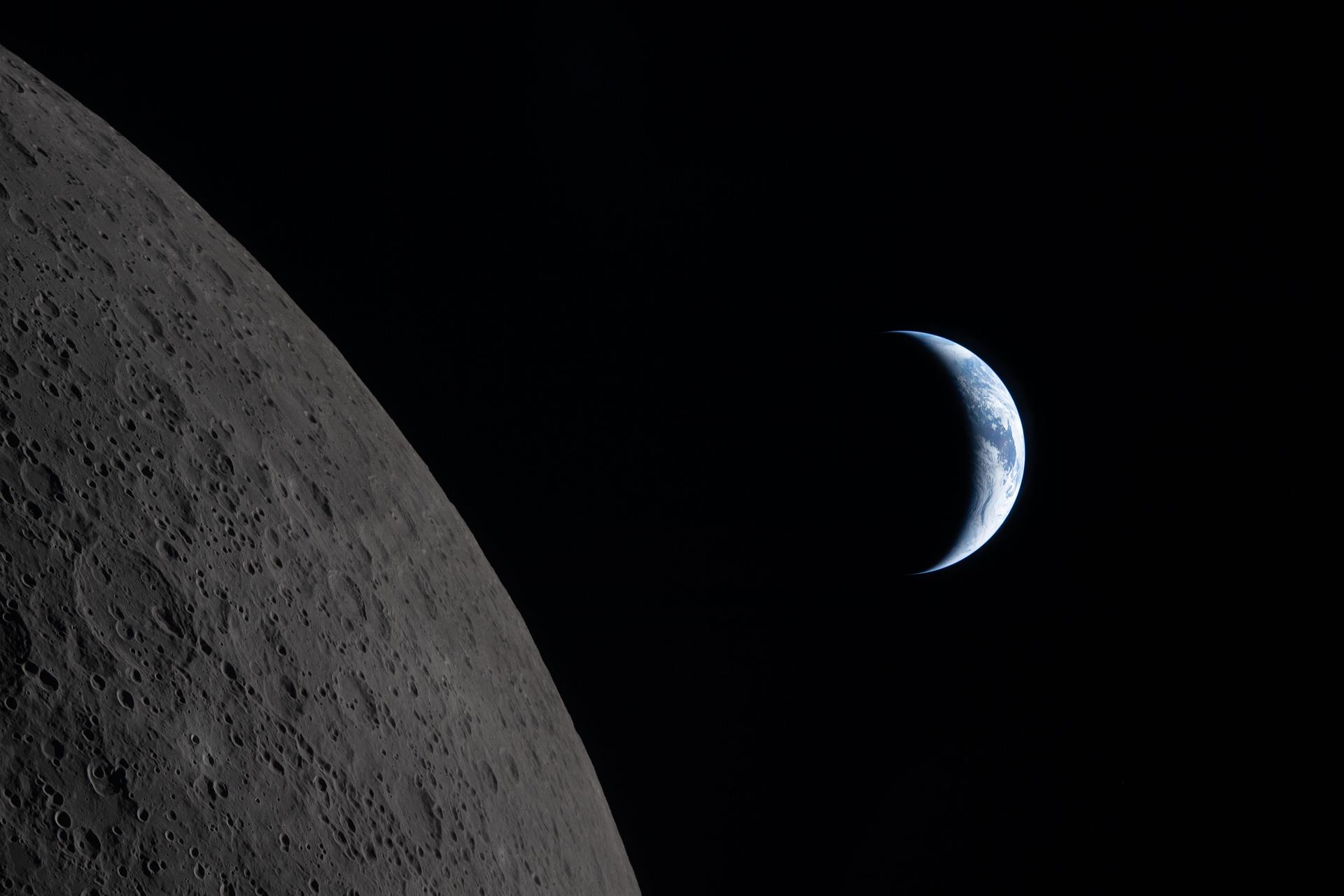
In light of the recent Artemis II [3] mission to return to the Moon for the first time in 50 years, I describe a simple computation of the distance to the Moon from almost first principles. This is a different derivation from the one performed by the Greeks and that is well known throughout the literature, i.e. that performed by Aristarchus of Samos [4] in 270 BC, and instead uses some relatively simple physics that many of us would have encountered in school.
In particular, with the use of a pendulum, a protractor, and some light physics, we get an approximation to the distance to the Moon within 1% accuracy of the true (average) value.
1 Physics #
We begin with an outline of the physics that will be necessary for this derivation.
1.1 Newton’s Law of Universal Gravitation #
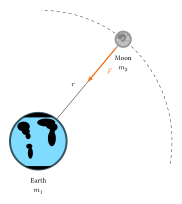
For two bodies of masses $m_1, m_2$ that are a distance $r$ apart (distance between their centres of mass), the gravitational force exerted by one body onto the other is given by the following inverse-square law
\[ F = \frac{G m_1 m_2}{r^2}, \]
where $G$ is the gravitational constant - which we need not know.
1.2 Newton’s Second Law #
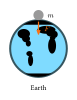
Newton’s second law states that the acceleration of a body, $a$, is directly proportional to the force experienced by it, $F$, and also inversely proportional to its mass, $m$; more commonly written as
\[ F = m a. \]
1.3 Centripetal Force #
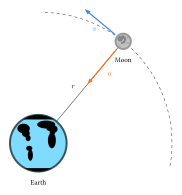
From the kinematics of curved motion, it is known that for an object moving at tangential speed $v$ along a path with radius of curvature $r$, its acceleration towards the centre of curvature is
\[ a = \frac{v^2}{r} . \]
Using $v = \omega r$, we can also write this in terms of the angular velocity $\omega = \frac{2 \pi}{T}$ for an orbital period of $T$.
\[ a = \frac{4 \pi^2 r}{T^2} . \]
1.4 Pendulum Period #
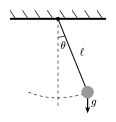
The period of the swing of a simple pendulum, $T$, depends on the length of the pendulum string, $\ell$, and the strength of local gravity $g$ via
\[ T = 2 \pi \sqrt{\frac{\ell}{g}} . \]
2 Formulation #
Armed with the elementary physics described above, we can now construct a simple equation for the distance to the Moon, by only requiring the knowledge of very few parameters, that can be relatively easily measured!
Recall that on the surface of the Earth, we experience a gravitational acceleration $g$ (assume not yet known, but to be measured). Furthermore, by Newton’s second law, the gravitational force experienced by a body on the surface of the Earth, with mass $M_B$, is given by $F = M_B g$.
Equivalently, via the inverse square law, this force may also be written as
\[ F = \frac{G M_E M_B}{R_E^2} \]
where $G$ denotes the universal gravitational constant (need not know), $M_E$ the mass of the Earth (need not know), and $R_E$ the radius of the Earth (assume not yet known, but to be measured). Equating these together and cancelling out $M_B$ yields the equation
\begin{equation} \label{eq-gE}\tag{1} g = \frac{G M_E}{R_E^2} . \end{equation}
Now, instead of a body on the surface of the Earth, consider the Moon of mass, $M_M$, and the gravitational force exerted on the Moon by the Earth, $F_M$, which by Newton’s second law would give $F_M = M_M a_M$, where $a_M$ denotes the acceleration towards the Earth experienced at the distance of the Moon. Similarly to the above, the inverse square law gives
\[ F_M = \frac{G M_E M_M}{D^2} \]
where $D$ denotes the distance between the centres of mass of the Earth and Moon. Equating these as before, and cancelling $M_M$, then gives
\begin{equation} \label{eq-gM}\tag{2} a_M = \frac{G M_E}{D^2} . \end{equation}
In particular, equating across $G M_E$ with Equations (1) and (2), we get
\begin{equation} \label{eq-gMgE}\tag{3} a_M D^2 = g R_E^2, \end{equation}
which already brings us much closer to the distance to the Moon.
Finally, observing that the Moon orbits roughly in a circular manner around the Earth, by the centripetal force equation, the centripetal acceleration (also the gravitation acceleration) experienced by the Moon can be expressed as
\begin{equation} \label{eq-aM}\tag{4} a_M = \frac{4 \pi^2 D}{T_M^2} \end{equation}
where $T_M$ denotes the orbital period of the Moon, which common knowledge suggests to be roughly once a month (say 28 days). Substituting now the expression of $a_M$ from Equation (4) into Equation (3) yields
\[ \left( \frac{4 \pi^2 D}{T_M^2} \right) D^2 = g R_E^2 \]
and after solving for $D$, we get
\begin{equation} \label{eq-moon}\tag{5} D = \left( \frac{g T_M^2 R_E^2}{4 \pi^2} \right)^{\frac{1}{3}} . \end{equation}
A simple formula for the distance between the centres of mass of the Earth and the Moon. To get the precise distance to the Moon, i.e. from surface to surface, a little extra measurement is required to determine the radius of the Moon (this can be done by observing eclipses), but it does not change the answer by much.
3 Measurement #
Having now obtained a simple formulaic expression of the distance to the Moon in Equation (5), we notice that we require the knowledge of only a few constants, that I will show are easily measured.
$\boldsymbol{\pi}$. Known for millennia as roughly $3.14$, and can be confirmed and measured at home by hand, see the excellent videos by Matt Parker on his YouTube channel StandUpMaths [1]. I will assume that this is known.
$\boldsymbol{T_M}$. The orbital period of the Moon, i.e. how long it takes the Moon to orbit the Earth; known and observed to be roughly 28 days. I will assume that this is known.
$\boldsymbol{g}$. The gravitational acceleration experienced on the surface of the Earth. An understanding of the value for $g$ has been known in the literature since 1651 by an account of Giovanni Battista Riccioli, although not in the common form of $9.81 \text{m s}^{- 2}$ as we know it today as this pre-dates the invention of the metre. Since this does not feel elementary, I will not assume that this is known, and we shall measure it directly using a pendulum, although dropping objects from a height and measuring the time it takes to drop can also be used.
$\boldsymbol{R_E}$. The radius of the Earth has been accurately known since 240 BC (more than 2000 years ago!), the first method recorded in the literature is that of Eratosthenes [2], which calculates the diameter of the Earth using the angle difference of shadows cast by the sun on a vertical rod at two different locations, and is determined to be roughly 6371 km. This also does not feel elementary, and therefore I will not assume this is known, and we shall measure it directly.
So we are left to measure only $g$ and $R_E$.
3.1 Gravitational Acceleration #
The measurement of $g$ can be made in a number of ways, but one of the simplest is via the use of a pendulum (for me, a string connected to a spare piece of plastic acting as the bob to provide tension). The period of a (small) swing, $T$, of a simple pendulum of length $\ell$ is known to depend on the strength of local gravity $g$ via
\[ T = 2 \pi \sqrt{\frac{\ell}{g}} . \]
Solving for $g$, we get
\[ g = \frac{4 \pi^2 \ell}{T^2} . \]
Therefore, it remains to measure $g$ by measuring the length of a simple pendulum and the period of its swings.
For this, I perform the experiment at home under the parameters $\ell = 0.6 m$, and I measure $T$ multiple times, $T_1, \ldots, T_n$, and compute corresponding $g_1, \ldots, g_n $ values. To reduce the noise in my computation, I select $g = \frac{1}{n} \sum_{i = 1}^n g_i$ to represent my estimator, i.e. the average of my observations. Doing so, I get the following measurements
\[ \begin{array}{l|lll} n & \ell [\text{m}] & T [\text{s}] & g [\text{m s}^{- 2}]\\ \hline 1 & 0.6 & 1.55 & 9.86\\ 2 & 0.6 & 1.57 & 9.60\\ 3 & 0.6 & 1.52 & 10.12 \end{array} \]
yielding an average value $g = 9.86 \text{m s}^{- 2}$, which is close enough to the generally accepted value of $9.81 \text{m s}^{- 2}$, although this does vary slightly depending on where you are on the planet.
I should note that the experiment performed by me was not entirely under strict scientific conditions with the most accurate measurement tools, e.g. my phone camera and myself simply dropping the pendulum, although more rigorous approaches are encouraged.
3.2 Radius of the Earth #
Regarding the radius of the Earth $R_E$, we may also compute this with a pendulum, although it becomes more physically challenging - you could measure $g$ at two different (known) heights above the surface of the Earth using the method above, and then via the inverse square law, can solve for $R_E$. Instead, we resort to the more traditional method of using the horizon.
Assume you stand on a tall object of height $h$ above the surface of the Earth, and measure the angle that the horizon makes versus when looking directly straight and perpendicular to where you are standing, calling this the drop angle, $\theta$. Drawing this out in a diagram, we notice that the point from which we are standing, the point on the horizon that we can see and the centre of the Earth make a right-angled triangle, with hypotenuse $R_E + h$, adjacent $R_E$, and the angle between the hypotenuse and the adjacent being $\theta$.
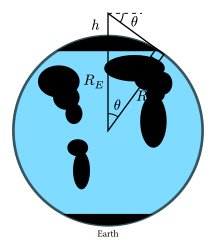
By simple trigonometry (i.e. SOHCAHTOA), we can write
\begin{eqnarray} \cos (\theta) & = & \frac{R_E}{R_E + h} . \nonumber \end{eqnarray}
Solving for $R_E$ then gives us
\begin{eqnarray} R_E & = & \frac{h \cos (\theta)}{1 - \cos (\theta)} . \nonumber \end{eqnarray}
Currently being in Sydney, I decided to make this measurement from the Sydney Tower Eye, which has a viewing platform roughly $h = 250\text{m}$ from sea-level (which we can also measure independently through a similar technique). Taking my trusty protractor, here I used a level measurement app on my phone for convenience and precision, although any accurate protractor will do, I was able to measure (again, not under any form of strict scientific procedure) the following
\[ \begin{array}{l|lll} n & h [\text{m}] & \theta [\deg] & R_E [\text{m}]\\ \hline 1 & 250 & 0.50 & 6, 565, 404\\ 2 & 250 & 0.55 & 5, 425, 918\\ 3 & 250 & 0.48 & 7, 123, 937 \end{array} \]
which yields an average value of $6, 371, 753 \text{m} \approx 6, 372\operatorname{km}$, roughly in line with the true value of $6350\operatorname{km}$.
4 Computation #
Having now obtained values for $g, R_E$ and also knowing the value of $\pi$ and $T_M$
\begin{eqnarray} \pi & = & 3.14 \nonumber\\\ T_M & = & 28\operatorname{days}= 2, 419, 200 \text{s} \nonumber\\\ g & = & 9.86\operatorname{ms}^{- 2} \nonumber\\\ R_E & = & 6372\operatorname{km} \nonumber \end{eqnarray}
we get the following estimate for the distance between the Earth and the Moon
>>> g=9.86
>>> TM=28*24*60*60
>>> RE=6372*1000
>>> pi=3.14
>>> D = (g*(TM**2)*(RE)**2/(4*(pi)**2))**(1/3)
>>> print(f'{int(D/1000)}km')
390197km
Using this simple method, we get $\boldsymbol{D \approx 390, 197}$km, versus the true value of $\approx 385, 000\operatorname{km}$, with roughly 1% error of the true value - a truly remarkable result!
Notes #
- The diagrams in this post were made in Typst using the package astro [5] - a package I created motivated by the TikZ-planets package for $\LaTeX$.